





Bay Alarm Medical SOS Smartwatch
Smartwatches have transformed the idea of portable technology by placing much of a smartphone’s computing capability directly on the wrist. Their convenience and everyday appeal have also changed the medical alert landscape. Many older adults have traditionally resisted wearing conventional emergency pendants or belt-clip devices because of their medical appearance, but modern smartwatches offer a more stylish and discreet alternative that blends naturally into daily life.
Companies such as Apple and Samsung continue expanding the capabilities of their smartwatch platforms, steadily adapting many smartphone features for wrist-based use. Alongside communication and entertainment functions, both brands now incorporate a growing range of health and wellness tools.
Dedicated medical alert providers, however, approach smartwatch technology from a different angle. Rather than building a general-purpose smart device with medical features added on, companies like Bay Alarm Medical have designed watches specifically around emergency response and personal safety, while still integrating useful health-related functions.
The contrast between these two approaches becomes clear when comparing the Bay Alarm Medical SOS Smartwatch and the Apple Watch.
Monitoring Center vs. Direct 911 Calling

One of the most important distinctions involves how emergencies are handled.
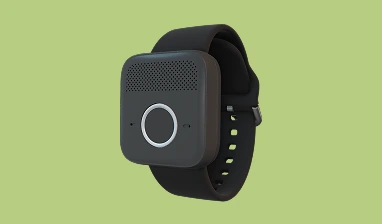
The SOS Smartwatch operates with built-in 4G cellular service and connects directly to Five Diamond-certified monitoring centers staffed around the clock. When an alert is activated, the wearer’s GPS location is transmitted automatically to trained operators who can communicate through the watch’s two-way speaker system.
The Apple Watch, by comparison, is designed to contact 911 directly during an emergency, whether initiated manually or triggered through its fall-detection feature. While this provides rapid access to emergency services, it can also create limitations. In some regions, emergency dispatch centers receive the alert similarly to a standard cellphone call, which may make pinpointing the user’s exact location more difficult despite the watch’s GPS capabilities.
A professional monitoring center also provides an additional layer of support that differs from a direct 911 connection. If the wearer cannot respond verbally, monitoring personnel can still escalate the emergency response process. In addition, operators may have access to important medical profile information about the subscriber, helping provide context to first responders that emergency dispatchers would not otherwise have.
Simplicity and Everyday Operation
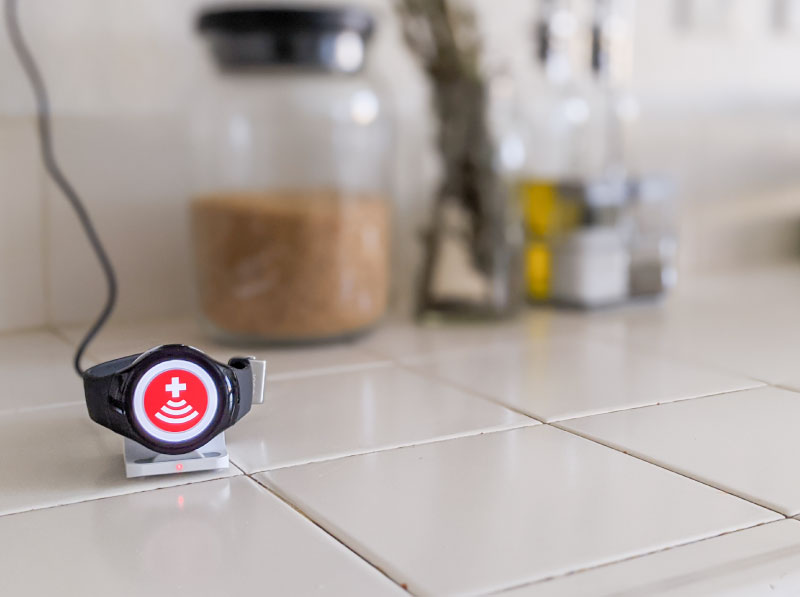
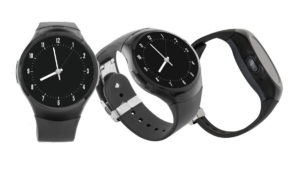
The SOS Smartwatch was created primarily as an emergency response device, and its design reflects that focus. Setup is relatively straightforward, and the interface emphasizes large, easy-to-read icons with simple navigation. Emergency assistance can be activated quickly by pressing and holding the physical side button.
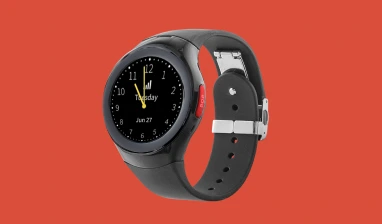
The Apple Watch offers a much broader ecosystem of functions, ranging from messaging and phone calls to music streaming and downloadable apps. Depending on the model, users may choose between standalone cellular capability or pairing with an iPhone. The expanded feature set naturally creates a more involved setup process and a more complex menu system.
Health and Lifestyle Features
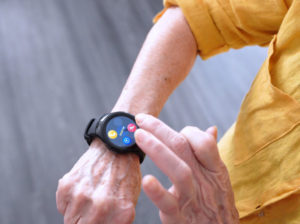
Bay Alarm Medical’s SOS Smartwatch includes wellness-oriented tools such as step tracking, allowing users to monitor daily activity and set movement goals. Additional health-related features continue to be developed, although the device remains centered on emergency protection rather than broad lifestyle functionality.
The Apple Watch lineup, meanwhile, incorporates an extensive collection of health and fitness technologies. Depending on the model and installed apps, users may access heart-rate monitoring, rhythm notifications, blood oxygen readings, and electrocardiogram (ECG) functions. Advanced sensors such as accelerometers and gyroscopes help power movement analysis and fall detection, while other built-in tools may include GPS, Wi-Fi, Bluetooth, altimeters, and digital compasses.
Price
The SOS Smartwatch costs $159 for the equipment, and $39.95 per month with no contracts and no upfront or other fees.
The Apple Watch can start as low as $199 for a basic GPS model and core fitness, health and connectivity features, and range up to a starting price of $499, and more, to include the higher end health tracking and connectivity functions (plus cellular service of your choice). Apple pairs only with its own products, by the way, while Samsung will pair with both Android and iOS systems.
Recommendations for Seniors

For the senior who already lives in the Apple universe, who is not daunted by the array of options and who may be interested in the monitored health data, one of the Apple Watch models may make a useful gift. Note however that the Apple Watch is only approved by the FDA for informational purposes, and doctors are concerned that the deluge of data no substitute for a real diagnosis, offering more possibilities for false alarms or wrong conclusions on the patient end.
If the objective is simply to supply a senior with a medical alert system that is unobtrusive and dedicated to health and medical alerts, then the SOS Smartwatch is the better choice. Built exclusively for its main purpose and without other data overhead, the SOS is also the lowest price. For the senior who may be daunted by, or simply doesn’t want, an array of extra features, the SOS Smartwatch performs as a dedicated medical alert system in a stylish and comfortable way, with a higher likelihood that the senior will actually use it.