









Most family caregivers reach a moment they would never confess out loud. After another sleepless night or another decline they can’t stop, a quiet thought surfaces: they wish it were over. Bay Alarm Medical surveyed 505 Americans caring for an aging parent to map the private, guilt-soaked thoughts that come with the role, and how often they surface.
What the data shows is something caregivers rarely hear. These thoughts aren’t rare, and they aren’t the mark of a person who loves less. They’re close to universal, and most caregivers carry them while believing they’re the only ones who do.
Key Takeaways
- Nearly half of caregivers (48%) have wished their aging parent’s suffering or pain would end.
- More than half of caregivers (51%) are also raising or supporting children while caring for a parent.
- More than 2 in 5 caregivers (41%) often delay their own healthcare for their parent, and more than 1 in 5 (22%) have never taken a full day off.
- 3 in 4 caregivers (75%) say simply knowing other caregivers feel the same way would ease their guilt.
- More than 1 in 3 caregivers (36%) have begun grieving a parent who is still alive, and more than 1 in 4 (26%) say it feels like losing them twice.
- Nearly 1 in 3 caregivers (31%) say no one knows how they truly feel.
- 13% of caregivers have confided “I wish it were over” thoughts to an AI chatbot.
- Caregivers raising children under 18 carry the heaviest guilt over their “I wish it were over” thoughts when compared to caregivers without young children at home (63% vs. 53%).
The Confessions Caregivers Keep to Themselves
We asked caregivers what private thoughts they had while caring for a parent, and the answers rarely leave those who have them.
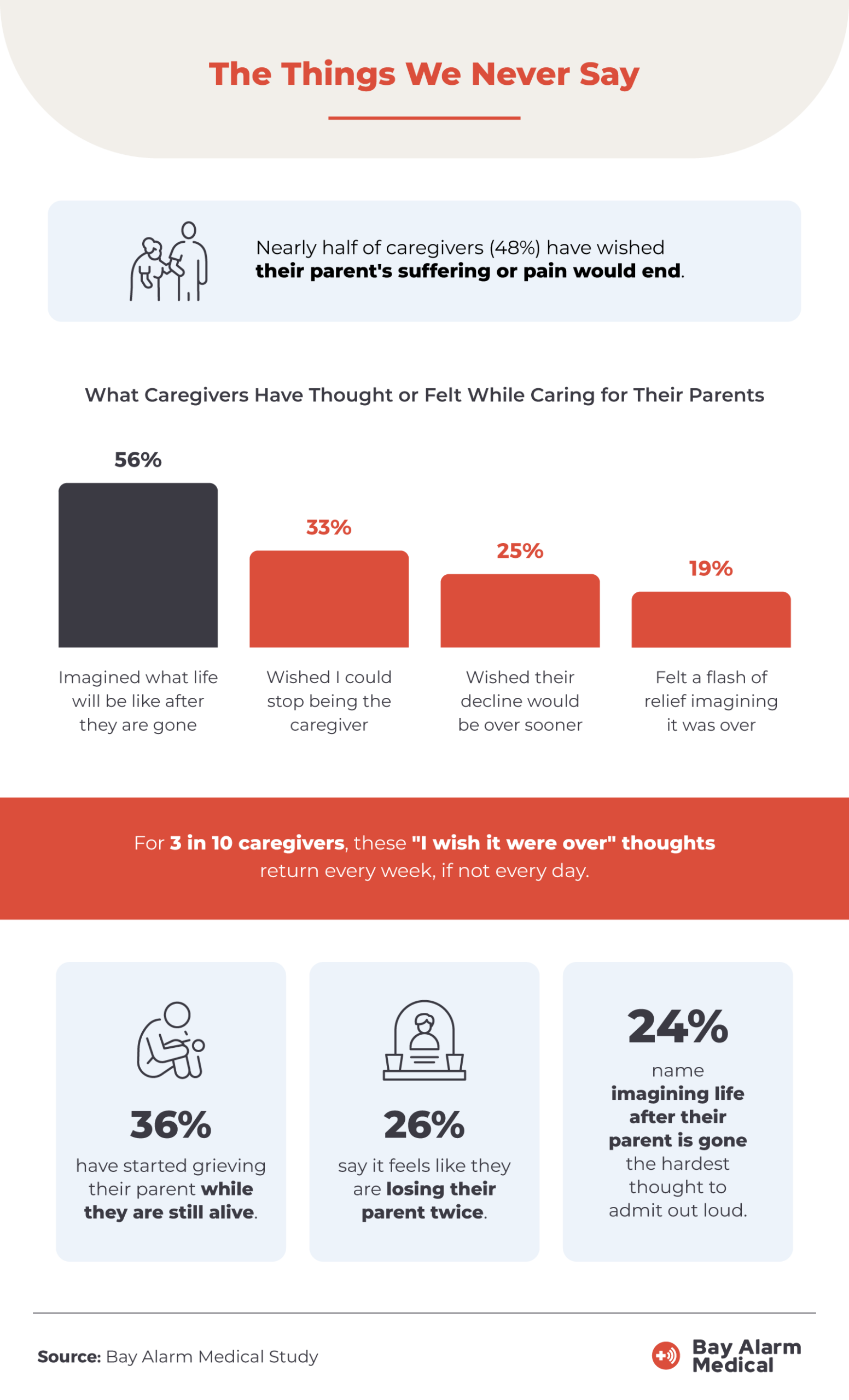
Nearly half of caregivers (48%) said they have wished their parent’s suffering or pain would end. More had gone further in their own minds: 56% had imagined what life would look like after their parent is gone, and a third (33%) had wished they could stop being the caregiver altogether. For 3 in 10, these thoughts were not one-time cracks but returned weekly, if not daily.
The grief often started early. More than a third of caregivers (36%) had begun mourning a parent who is still alive, and 26% said it feels like losing them twice. Women were more likely than men to have started grieving a parent who was still alive (41% vs. 30%).
Among those who had felt a flash of relief imagining it was over, 59% said the guilt sat heavily, while 41% had made peace with it. The thought caregivers found hardest to admit was imagining life after a parent is gone, named by 24%.
The youngest caregivers carried “I wish it were over” thoughts the most. Gen Z caregivers were more likely to have wished their parent’s suffering would end (56%) than Gen X (47%) and millennial (46%) caregivers. More than 1 in 3 overall (35%) said their parent now feels like a different person than the one they knew.
What Tips Caregivers Into the Darkest Thoughts
When we asked what drives these thoughts, one answer rose above exhaustion, money, and lost sleep.
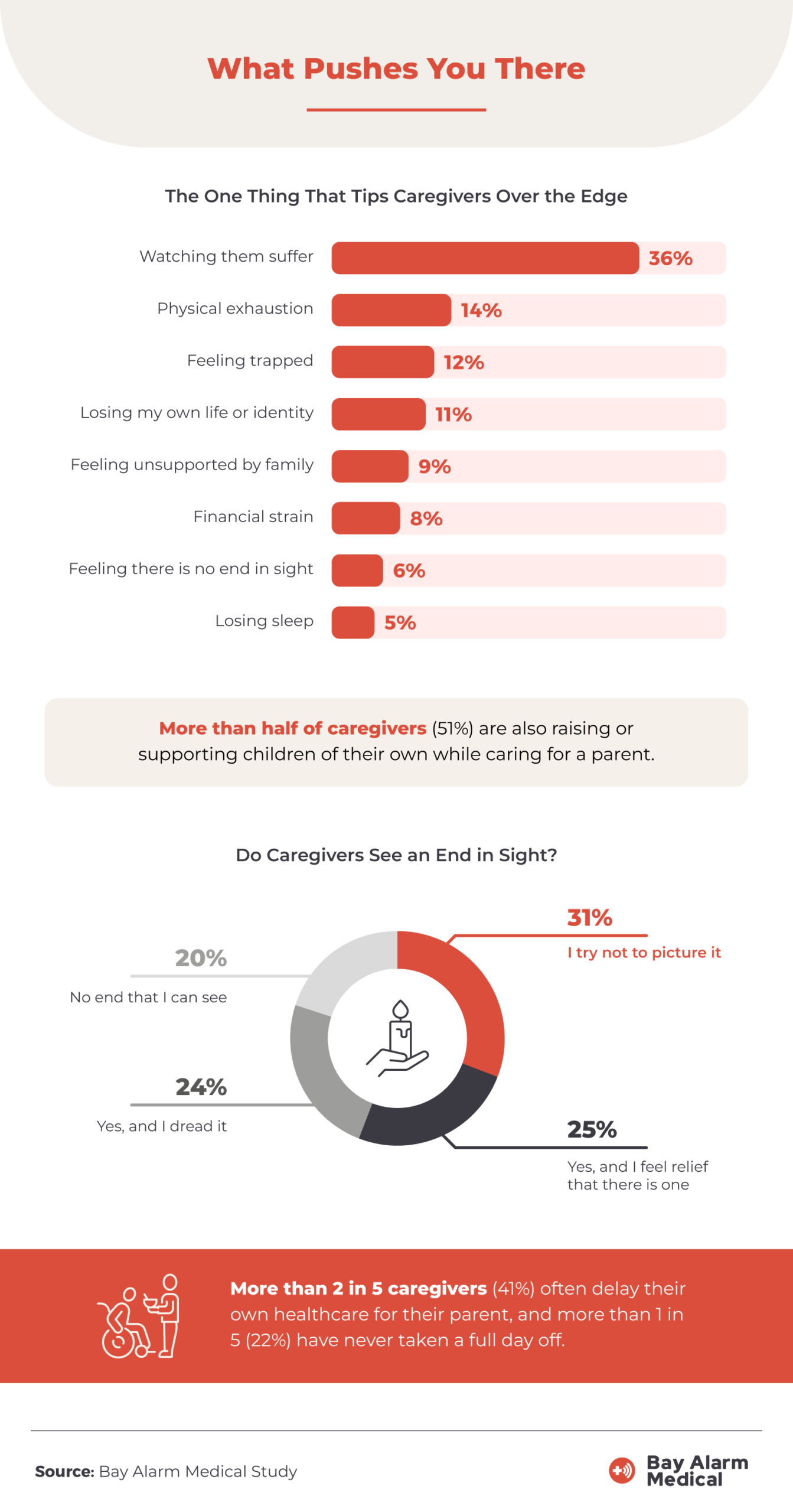
Watching a parent suffer was the trigger caregivers pointed to most. Asked to name the single thing that most tips them into “I wish it were over” thoughts, 36% chose watching their parent suffer, more than double physical exhaustion (14%). When they could select everything that applied, 56% named watching a parent suffer, ahead of exhaustion (40%) and feeling trapped (38%).
The weight rarely lets up. More than half of caregivers (51%) were also raising children under 18 at home while caring for a parent, and this sandwiched group carried the heaviest guilt over their “I wish it were over” thoughts (63% vs. 53% of those without young children at home).
Most caregivers had been caring for a parent for 3 to 5 years (36%), with another 20% doing so for more than 5 years. Only 1 in 4 (25%) saw an end to caregiving and felt any relief that one existed, while 1 in 5 (20%) saw no end at all. The caregivers who dreaded the end or saw none carried the most guilt over these thoughts, at 65% and 61%, when compared with those who tried not to picture the future (51%).
The cost also falls on the caregivers’ own health. More than 2 in 5 (41%) said they often delay their own healthcare because their parent comes first, and more than 1 in 5 (22%) had never taken a full day away. Women were more likely than men to have never taken a day off (26% vs. 16%).
Alone in a Feeling Almost Every Caregiver Shares
The loneliest part of caregiving may be believing these thoughts belong to you alone.
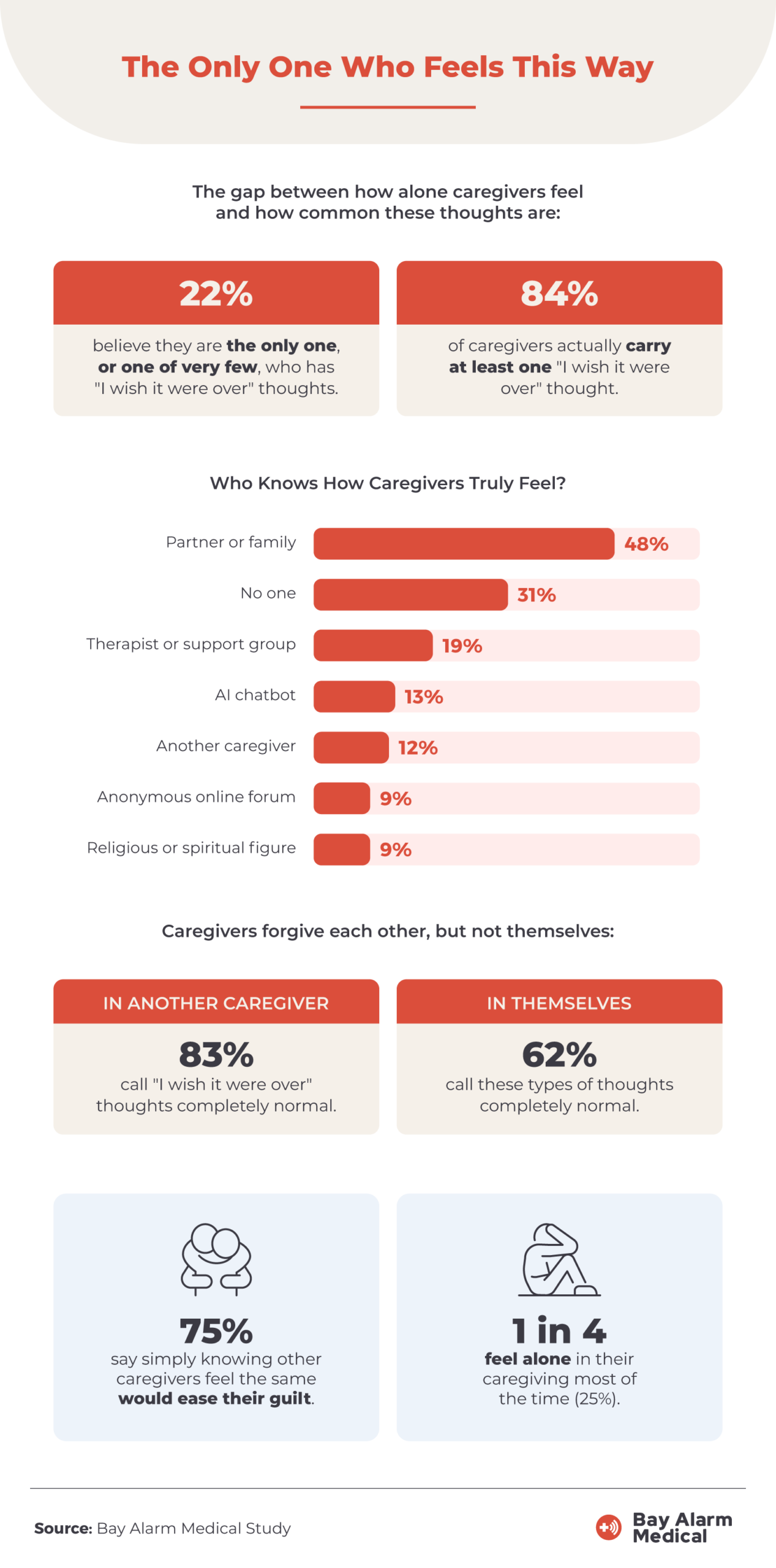
The gap between perception and reality was stark. While 84% of caregivers reported at least one “I wish it were over” thought, 22% believed they were the only one, or one of very few, who did so. Nearly 1 in 3 (31%) said no one in their life knows how they truly feel. More caregivers had confided these thoughts to an AI chatbot (13%) than had told another caregiver, and among Gen Z, that figure rose to 17%.
Caregivers extended grace to others that they would not extend to themselves: 83% said the exact same thought was completely normal in another caregiver, but only 62% granted themselves the same. Most kept their guilt private, with 47% handling it alone and 71% worrying at least sometimes that these thoughts made them a bad son or daughter.
What most said would help was strikingly simple. About 3 in 4 caregivers (75%) said just knowing other caregivers feel the same way would ease their guilt about their thoughts. Financial help and a real break also tied as the most requested support, each named by 52%. Mental or emotional support followed at 49%.
What These Numbers Ask of Us
The “I wish it were over” thought is not evidence of a caregiver who loves too little. It’s the sound of a person carrying more than one person was meant to carry, usually in silence. If you recognize yourself in these numbers, the data offers one steadying fact: you are in the majority, not the exception. Saying the thought aloud to someone who understands, whether a friend, a support group, or a professional, is where the weight starts to lift.
Methodology
For this study, Bay Alarm Medical surveyed 505 Americans who currently help care for or support an aging parent or parent-in-law, to explore the time, money, and personal toll of caregiving. The average age was 41; 57% of respondents were women, 41% were men, and 2% self-described or preferred not to say. By generation, 4% were baby boomers, 29% were Gen X, 50% were millennials, and 17% were Gen Z. Totals may not equal 100 due to rounding
About Bay Alarm Medical
Bay Alarm Medical helps older adults live independently, safely, and with confidence through medical alert systems built without contracts or added complexity. Our mission is to deliver dependable, compassionate support that gives peace of mind to users and the families who care for them. Learn more at bayalarmmedical.com.
Fair Use Statement
You’re welcome to share the findings and graphics from this study for noncommercial purposes. We ask only that you link back to this page so readers can view the full study and its methodology, and so the caregivers who shared their experiences are properly credited.